Among the dozens of disposable drinkware formats on the market, the 16oz Plastic Clear Cup has become a global standard. Its 450 ml capacity hits the sweet spot for iced beverages, its transparent body turns every drink into a visual experience, and its dimensional consistency allows it to stack neatly inside high-volume logistics chains. This guide examines the engineering, materials, and procurement decisions behind the format — and explains why manufacturers like Zhejiang Gaokai New Material Co., Ltd. have built dedicated production lines around it.
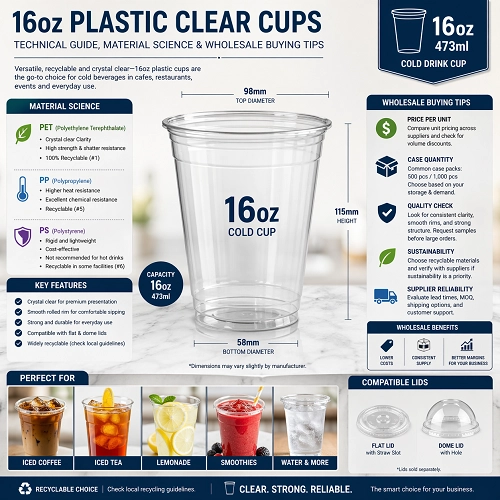
Sixteen fluid ounces (≈ 473 ml, sold as 450 ml fill-to-rim in metric markets) is not an arbitrary number. It sits at the intersection of consumer habit — the "large" size at most coffee chains — and structural physics. A cup taller than roughly 120 mm without a diameter increase becomes top-heavy; a cup wider than 100 mm no longer fits standard lids and cup holders. The 16oz Plastic Clear Cup (model GK98/16C) from Gaokai resolves this tension with a 98.4 mm caliber, 61.3 mm base, and 121.0 mm height — a geometry that maintains stability while maximising volumetric efficiency per carton.
| Item No. | Capacity | Weight | Caliber (Top Ø) | Base Ø | Height | Pcs / Sleeve | Qty / Carton |
|---|---|---|---|---|---|---|---|
| GK98/16C | 16 oz (≈ 450 ml) | 14.0 g | 98.4 mm | 61.3 mm | 121.0 mm | 50 pcs × 20 sleeves | 1,000 pcs |
At 14 g per unit, the cup achieves a wall gauge that resists lateral squeeze from a full-handed grip while keeping raw-material cost competitive. The 98.4 mm rim diameter is an industry-standard dimension that ensures interoperability with a wide range of flat and domed lids, an important consideration for PET series buyers managing multi-SKU lid inventories.
Not all clear cups are made equal. The resin selected for a 16oz cup determines its optical clarity, chemical resistance, thermal limits, and end-of-life pathway. Gaokai produces across three distinct material streams — PET, PLA, and RPET — each suited to a different use case.
| Property | PET | RPET | PLA |
|---|---|---|---|
| Optical clarity | Excellent | Excellent | Good |
| Max service temp (cold use) | Up to 60 °C | Up to 60 °C | Up to 45 °C |
| Post-consumer recycled content | 0 % | Up to 100 % | N/A (bio-based) |
| Recyclability | High (resin code 1) | High (resin code 1) | Industrial compost only |
| Carbon footprint vs. virgin PET | Baseline | Lower (30–60 %) | Lower (if composted) |
| Typical application | Cold beverages, smoothies | Eco-certified events, retail | Compostable service operations |
For the vast majority of foodservice applications — iced lattes, bubble tea, cold-pressed juices — food-grade PET remains the material of choice due to its pristine clarity and proven food-contact safety record. Buyers with sustainability mandates often pivot to the RPET series, which delivers identical geometry and clarity while incorporating recycled post-consumer resin.
The GK98/16C is produced via thermoforming — the dominant process for thin-gauge clear cups. A pre-extruded PET/RPET/PLA sheet is fed through a forming machine, heated to the polymer's forming temperature, and drawn down over a precision aluminium tool. The formed cups are then punched out, stacked, sleeved, and cartoned within a largely automated cell.
Gaokai's manufacturing technology is built around 16 forming machines with an annual capacity of 2 billion pieces. The company operates an intelligent stereoscopic warehouse management system that coordinates production scheduling with outbound logistics — a critical capability for buyers requiring short lead times on large orders. The facility is located inside the Wankai New Materials industrial park in Haining, Zhejiang, giving it direct upstream access to premium PET sheet supply.
Any cup destined for food contact must comply with national and international food-safety regulations. For cups sold into North American markets, the relevant standard is FDA 21 CFR; for the EU, Regulation (EC) No 10/2011 on plastic materials and articles intended to contact food. Gaokai's products are manufactured from food-grade resins and the company holds relevant certifications — details are available on the Certification page.
| Standard / Regulation | Scope | Implication for Buyers |
|---|---|---|
| FDA 21 CFR §177.1630 | USA | PET polymer permitted for repeated food contact |
| EU Regulation 10/2011 | European Union | Positive list of substances; migration limits |
| GB 4806.7-2016 | China | National standard for plastic food containers |
| ISO 22000 | Global | Food-safety management system |
The commercial reach of the 16oz format is broad. Below are the primary sectors and the specific properties that make the format suitable for each.
Single-use plastic legislation is tightening in the EU, UK, and several US states. Buyers sourcing 16oz clear cups today need a material roadmap. Gaokai addresses this across three pillars:
When evaluating a wholesale source for 16oz Plastic Clear Cups, the following technical and commercial criteria matter most:
| Criteria | What to Verify | Why It Matters |
|---|---|---|
| Material declaration | PET, RPET, or PLA; virgin vs. recycled content % | Regulatory compliance & sustainability claims |
| Wall thickness consistency | Gauge tolerance across the batch | Prevents collapse or leakage in service |
| Lid compatibility | Confirm 98 mm lid SKU fits rim seam | Avoids mismatched inventory |
| Production capacity | Monthly output & lead time | Ensures supply continuity during peak seasons |
| Food-safety certification | FDA, EU, or GB certificates on file | Required by most retailers & chains |
| Customisation options | Printing, embossing, custom colour | Brand differentiation at point of sale |
| MOQ & carton configuration | Minimum order quantity per SKU | Cash-flow and warehouse planning |
If the 16oz format is your anchor SKU, building a complementary range around it reduces sourcing complexity. Gaokai's catalogue includes several compatible options:
Sourcing these alongside your 16oz Plastic Clear Cups from a single supplier streamlines logistics, consolidates quality oversight, and often qualifies orders for better freight terms.
Zhejiang Gaokai New Material Co., Ltd. was established in 2021 in the Jianshan New District of Haining, Zhejiang — within the Wankai New Materials industrial park, one of China's leading PET raw-material production hubs. In a short time, the company has scaled to 16 thermoforming machines, an annual output of 2 billion pieces, and a distribution footprint spanning more than 21 countries and regions.
The company's product range covers PET, PLA, and RPET food containers — all manufactured under rigorous quality systems with full-process technology from raw-sheet production through thermoforming, printing, and automated warehousing. The Why Choose Us section of the company's website details its product advantages, technical equipment, and global sales network for prospective buyers conducting due diligence.