Polyethylene terephthalate — better known by its abbreviation PET — is the transparent workhorse of modern food-service packaging. Walk into any bubble-tea shop, juice bar, hospital cafeteria, or sports stadium and you will almost certainly encounter PET plastic cups: crystal-clear, impressively rigid, and light enough to handle with one hand. Yet behind their deceptively simple appearance lies a sophisticated interplay of polymer science, precision engineering, food-safety regulation, and an increasingly urgent conversation about end-of-life recyclability.
PET is a semi-crystalline thermoplastic polyester produced by the condensation polymerisation of ethylene glycol (EG) and terephthalic acid (PTA). The repeat unit is an ester linkage — hence the "polyester" designation — and the resulting macromolecule has an intrinsic viscosity (IV) that determines its end-use suitability. Bottle-grade PET typically carries an IV of 0.72–0.84 dL/g, while sheet-grade resin for thermoformed cups falls in the 0.70–0.80 dL/g range.
The backbone of PET alternates between rigid aromatic rings (from the terephthalate moiety) and flexible aliphatic segments (from the ethylene glycol). This combination delivers an unusually balanced property profile: the aromatic rings confer stiffness and UV resistance, while the ester linkages allow the chains to pack into ordered crystalline lamellae when cooled slowly — or to be quenched into an amorphous, optically clear state when cooled rapidly. Clear food cups deliberately exploit the amorphous state: fast quenching during thermoforming locks in transparency while preserving adequate mechanical strength.
The degree of crystallinity has a profound effect on end-product performance. Amorphous PET (APET) — used for most clear beverage cups — has a glass-transition temperature (Tg) of approximately 75–80 °C. Crystallised PET (CPET) can withstand temperatures up to 220 °C and is used for ovenable trays, but its opacity makes it unsuitable for display packaging.
Not all PET is interchangeable. Cup manufacturers source thermoforming-grade sheet resin, which is extruded into rolls (typically 0.25–1.0 mm thick) before being fed into thermoforming presses. Sheet quality — particularly its homogeneity in thickness, its level of acetaldehyde (AA) off-gassing, and the absence of gel particles or black specks — is the foundation on which cup quality is built. Gaokai's strategic co-location within the Wankai New Material Industrial Park in Haining, Zhejiang — home to one of China's largest PET resin producers — gives the company privileged access to premium upstream material, shortening the supply chain and tightening quality control.
The production of clear PET cups is a multi-stage industrial process that demands high precision at each step. The dominant manufacturing method is continuous roll-fed thermoforming, though injection-moulded cups exist in niche segments.
Incoming PET pellets must be dried to a moisture content below 50 ppm before extrusion. Residual moisture causes hydrolytic chain scission during melt processing, dramatically reducing molecular weight and compromising finished-cup clarity and mechanical performance. Industrial desiccant dryers operate at 160–180 °C for 4–6 hours, with dew-point control typically set at −40 °C or lower.
Dried pellets are fed into a single- or twin-screw extruder operating at 260–285 °C. The molten PET is forced through a flat sheet die, then rapidly quenched on polished chill rollers to produce optically clear, amorphous sheet. Thickness uniformity across the web is critical: ±5% tolerance is standard, with premium suppliers achieving ±3%. Deviations in thickness translate directly into wall-thickness inconsistencies in the finished cup.
The continuous PET sheet is fed into a thermoforming press where it is reheated to 90–130 °C — just above Tg but below the crystallisation temperature — and then drawn over or into a mould using a combination of mechanical plug assist and vacuum or compressed air. Plug assist is essential for producing cups with high draw ratios (depth-to-diameter): without it, material distribution is uneven, producing thin bases and thick rims.
Gaokai operates 16 sets of advanced forming machines at its Haining facility, delivering annual production capacity of over 2 billion pieces. The company's integrated approach — linking raw-material sourcing, sheet extrusion, and thermoforming under a coordinated production-scheduling system — minimises lead times and maintains tight dimensional control across all SKUs.
After forming, the cups remain in a continuous web that must be trimmed by steel-rule or rotary-knife die. The rim of each cup is then rolled or curled — a step that serves both functional and aesthetic purposes: the rolled rim adds stiffness, prevents cracking during lid application, and eliminates sharp edges that could injure end-users. Rim geometry must precisely match the corresponding lid sealing surface to achieve consistent dome retention or flat-lid seating.
PET cups can be printed using offset, digital, or screen processes — either directly on the cup or via in-mould labelling (IML) and sleeve application. Ink systems must be food-contact compliant (low migration) and must adhere to the slick PET surface, typically requiring either corona pre-treatment or UV-curable inks. Gaokai offers a PET Colour Series featuring vibrant colour options that expand brand expression beyond standard clear cups.
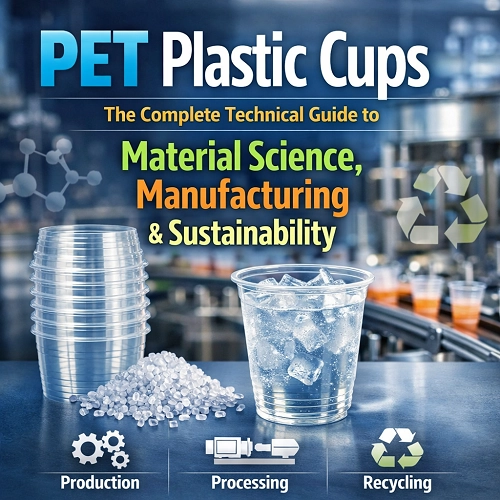
PET's dominance in cold-beverage packaging is not accidental. It emerges from a combination of optical, mechanical, thermal, and barrier properties that few other materials can match at comparable cost.
| Property | PET (APET) | PP | PLA | Unit |
|---|---|---|---|---|
| Density | 1.33–1.35 | 0.90–0.91 | 1.21–1.25 | g/cm³ |
| Tensile Strength | 47–90 | 25–40 | 40–60 | MPa |
| Flexural Modulus | 2,100–3,100 | 1,100–1,700 | 2,700–4,000 | MPa |
| Glass Transition Temp. | 75–80 | −10 to 0 | 55–60 | °C |
| Light Transmission | 87–90 | ~60 | 85–90 | % |
| O₂ Permeability | 4–10 | 150–400 | 8–20 | cc·mm/m²·day·atm |
| Recyclability | Widely recycled (#1) | Moderate (#5) | Limited (industrial composting) | — |
For cold-fill applications — carbonated soft drinks, iced coffee, smoothies, bubble tea — PET's oxygen transmission rate (OTR) of 4–10 cc·mm/m²·day·atm is adequate to protect flavour over a typical retail shelf life. Water-vapour transmission is similarly low, preventing desiccation of sensitive products. However, PET is not suited for hot-fill without orientation: unoriented APET cups begin to deform above 65–70 °C due to approach of Tg.
A well-designed PET cup must withstand the compressive forces experienced during stacking (typically 8–12 bar column loads) without collapse or sidewall buckling. Wall-thickness profiles — thicker at the rim and base, slightly thinner at the midpoint — are engineered during thermoforming via plug geometry and sheet-draw ratio. Gaokai's mould designs prioritise smooth, uniform wall formation and what the company describes as "humanised, anti-overflow" profiles that improve both structural performance and user ergonomics.
The commercial PET cup market encompasses a wide range of calibers, volumes, and lid-sealing formats. Gaokai's PET Series covers cup calibers from 78 mm through to 117 mm — each matched with dedicated lid types — providing operators with a coherent modular system.
A PET cup that fails food-safety requirements is commercially worthless regardless of its mechanical properties. Global procurement teams now routinely demand proof of compliance with multiple overlapping regulatory and certification frameworks.
In the European Union, food-contact plastics are governed primarily by Regulation (EU) No. 10/2011 on plastic materials and articles intended to contact food. This regulation establishes positive lists of authorised monomers, additives, and processing aids, along with overall migration limits (OML) of 10 mg/dm² and specific migration limits (SMLs) for individual substances. In the United States, the FDA regulates food-contact materials under 21 CFR Parts 174–178. China applies GB 4806.7-2016 for food-contact plastic materials and articles. Reputable cup manufacturers must comply with the regulations of their target export markets — not merely their domestic standards.
Zhejiang Gaokai has assembled a comprehensive certification portfolio that enables it to supply global markets with confidence. Certifications held by Gaokai include:
| Certification | Scope | Significance |
|---|---|---|
| ISO 9001:2015 | Quality Management System | Systematic process control across all production stages |
| ISO 14001:2015 | Environmental Management | Demonstrates commitment to minimising environmental impact |
| ISO 45001:2018 | Occupational Health & Safety | Worker safety and risk management |
| ISO 22000 / FSSC | Food Safety Management | Hazard analysis and control throughout the food-packaging supply chain |
| BRC A+ | Global Packaging Standard | Highest grade under BRCGS — demanded by major UK and European retailers |
| GRS (Global Recycled Standard) | Recycled Content Verification | Independent chain-of-custody verification for RPET products |
| SGS | Third-Party Testing | Migration testing, heavy-metals screening, physical verification |
PET cup applications have expanded well beyond their original soft-drink roots. Today, PET cups appear across an extraordinarily diverse set of foodservice and retail contexts:
No application segment has driven more innovation in PET cup design over the last decade than bubble tea. The unique demands of boba — dense tapioca pearls at the base, layered liquid, and wide-bore straw penetration — have pushed manufacturers to develop U-shaped and round-bottom cup profiles, oversized dome lids with cross-cut straw slots, and straw-free sip lids for markets where single-use plastic straw regulations apply. Gaokai's PET Ice Cup range and colourful PET Series address this segment specifically.
Hospitals, long-term care facilities, and institutional catering present a distinct set of requirements: strict hygiene audits, portion-size standardisation, and often government-mandated procurement rules. PET cups in this sector tend to favour smaller calibers (78–90 mm) with secure flat lids and clear sidewalls that allow visual checking of liquid levels without opening the cup.
Purchasing PET cups for a foodservice operation or retail brand involves balancing several interdependent variables. The following decision framework covers the most critical factors:
What is the maximum temperature of the beverage at fill? For cold-fill and ambient applications (iced teas, smoothies, bubble tea), standard APET is ideal. For hot-fill beverages above 65 °C, consider speciality crystallised PET (CPET) or alternative materials. Carbonated beverages require cups with adequate CO₂ barrier and sufficient stacking strength to withstand internal pressure during high-speed filling.
Rim caliber is the master specification that determines lid compatibility. Once a caliber is chosen — say 90 mm — it is generally advisable to select cups and lids from a single manufacturer's coordinated range to guarantee consistent sealing geometry. Gaokai's product matrix covers calibers from 78 mm to 117 mm with matched lid types at each diameter.
Three primary lid formats serve most applications. Flat lids (PET Flat Lid) minimise material use and stack compactly. Dome lids (Plastic Dome Cup Lid) accommodate whipped cream and tall garnishes. Straw-free sip lids (PET Straw-Free Lid) comply with single-use plastics directives in the EU and UK while maintaining a premium drinking experience.
If you are procuring for the European market, BRC and ISO 22000 are non-negotiable for major retail channels. If sustainability claims are part of your brand proposition, GRS certification for RPET content is essential. Third-party SGS migration test reports provide the documentary evidence needed to satisfy corporate social responsibility (CSR) auditors and regulatory inspections.
Large-format food-service operators typically run annual volumes that justify direct factory relationships, with minimum order quantities (MOQs) negotiated in full-truck-load equivalents. With capacity exceeding 2 billion pieces annually and an intelligent warehouse management system, Gaokai is structured to handle both large-volume commitments and responsive replenishment requirements across its 21+ country sales network.