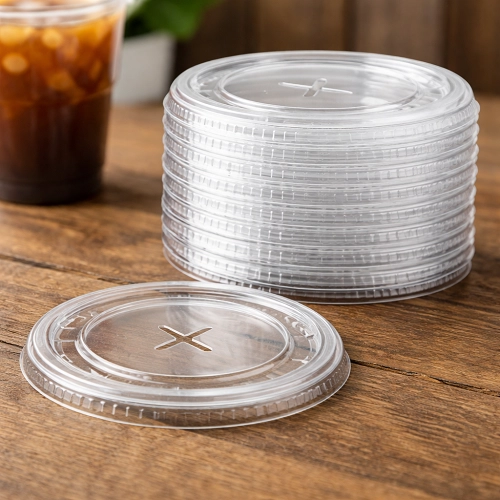
Plastic PET (Polyethylene Terephthalate) flat lids are widely used across foodservice, beverage, retail, and industrial packaging due to their clarity, strength-to-weight ratio, and recyclability. Flat lids—distinct from dome or sip-through designs—offer a low-profile seal that prioritizes stackability, spill resistance, and product visibility.
1. Material Science of PET
PET is a thermoplastic polyester formed by the polymerization of ethylene glycol and terephthalic acid (or dimethyl terephthalate). Key material properties relevant to flat lids include:
- Optical clarity: High light transmission enhances product presentation.
- Mechanical strength: Excellent tensile strength and impact resistance at thin gauges.
- Barrier properties: Moderate oxygen and moisture barriers suitable for cold foods and beverages.
- Thermal behavior: Glass transition temperature ~70–80 °C; suitable for cold-fill and short contact with warm contents, but not for high-heat applications.
- Chemical resistance: Stable against dilute acids and oils commonly found in foods.
Additives (UV stabilizers, slip agents, antistats) may be compounded to tailor performance without significantly compromising recyclability when used judiciously.
2. Design Characteristics of Flat Lids
Flat lids are engineered for secure sealing and efficient logistics:
- Rim geometry: Precision-molded snap-fit or interference-fit rims ensure compatibility with standardized cup diameters (e.g., 90 mm, 98 mm).
- Seal integrity: Uniform wall thickness and controlled crystallinity prevent stress whitening and cracking.
- Surface features: Optional straw slots, cross-cuts, or perforations can be incorporated while maintaining a flat profile.
- Stackability: Flat architecture reduces nesting height, improving storage density and lowering transportation costs.
Design tolerances are critical; even minor deviations can affect leak resistance and consumer usability.
3. Manufacturing Processes
PET flat lids are primarily produced via thermoforming, with occasional use of injection molding for thicker or specialty designs.
- Sheet extrusion: PET pellets are dried (to <50 ppm moisture) and extruded into sheets; moisture control prevents hydrolytic degradation.
- Thermoforming: Heated sheets are formed over precision molds using vacuum/pressure; rapid cooling preserves clarity.
- Trimming: Steel-rule or matched-metal dies ensure clean edges and dimensional accuracy.
- Quality control: In-line vision systems inspect for short shots, rim defects, and particulate contamination.
Process parameters—sheet temperature, forming pressure, and cooling rate—directly influence lid clarity and snap performance.
4. Performance and Functional Considerations
When specifying PET flat lids, engineers evaluate:
- Leak resistance: Depends on rim stiffness, cup compatibility, and tolerance stack-up.
- Impact resistance: Drop testing simulates handling and delivery conditions.
- Environmental stress cracking (ESC): Exposure to oils or cleaning agents can induce cracking; resin selection and annealing help mitigate risk.
- Shelf life: PET maintains dimensional stability over typical cold-chain timelines but can creep under sustained load at elevated temperatures.
5. Food Safety and Regulatory Compliance
PET flat lids intended for food contact must comply with applicable regulations:
- Food-contact approvals: Resins and additives must meet regional standards (e.g., FDA, EFSA).
- Migration limits: Testing ensures no harmful substances migrate into food under intended use conditions.
- Traceability: Batch coding and resin lot documentation support recall readiness and compliance audits.
Flat lids are typically approved for single-use applications; reuse may introduce hygiene and mechanical risks unless explicitly designed and certified otherwise.
6. Sustainability and Environmental Impact
PET is among the most recycled plastics globally, and flat lids can support circularity when designed responsibly:
- Recyclability: Clear, unpigmented PET with minimal additives is most compatible with existing recycling streams.
- Design for recycling: Avoid multi-material laminations, metallic inks, and incompatible labels.
- Lightweighting: Reducing gauge thickness lowers material use and carbon footprint while maintaining performance through ribbing or optimized geometry.
- Recycled content (rPET): Incorporating post-consumer recycled PET reduces virgin resin demand; food-contact rPET must meet strict decontamination standards.
Proper consumer guidance—clear disposal instructions and on-pack recycling symbols—improves recovery rates.
7. Application Areas
PET flat lids are commonly used in:
- Cold beverages: Iced coffee, smoothies, juices.
- Prepared foods: Salads, desserts, deli items.
- Retail packaging: Clear lids for grab-and-go merchandising.
- Industrial uses: Protective covers for components where visibility and dust protection are required.
Each application may prioritize different attributes—clarity for retail, seal strength for delivery, or cost efficiency for high-volume foodservice.
8. Limitations and Alternatives
Despite their versatility, PET flat lids have constraints:
- Heat resistance: Not suitable for hot-fill or microwave use.
- Impact at low temperatures: Brittleness can increase in freezing conditions.
- Environmental perception: Single-use plastics face increasing scrutiny.
Alternatives include polypropylene (higher heat tolerance), paper-based lids with coatings, or compostable bioplastics—each with trade-offs in performance, cost, and infrastructure compatibility.
Plastic PET flat lids represent a technically refined solution balancing clarity, strength, manufacturability, and recyclability. Optimal performance depends on informed material selection, precise design, controlled manufacturing, and alignment with regulatory and sustainability goals. When specified and used correctly, PET flat lids remain a reliable, efficient component of modern packaging systems—particularly for cold food and beverage applications where presentation and logistics efficiency are paramount.